Orders@pcbamake.com

A seemingly ordinary circuit board may hide a complex multi-layer maze. Judging the number of PCB layers is not only related to cost control, but also an important basis for circuit design optimization.
Visual observation method
1. Observe the delamination line on the edge of the board
Method: Observe the side of the PCB board against the light. The edge of the multi-layer board usually shows the delamination line of different materials (there is a boundary line of resin or copper foil between each layer).
Note:
Low-layer number (such as less than 4 layers) may be easier to see the delamination.
High-layer number (such as more than 8 layers) may not be obvious due to tight lamination.
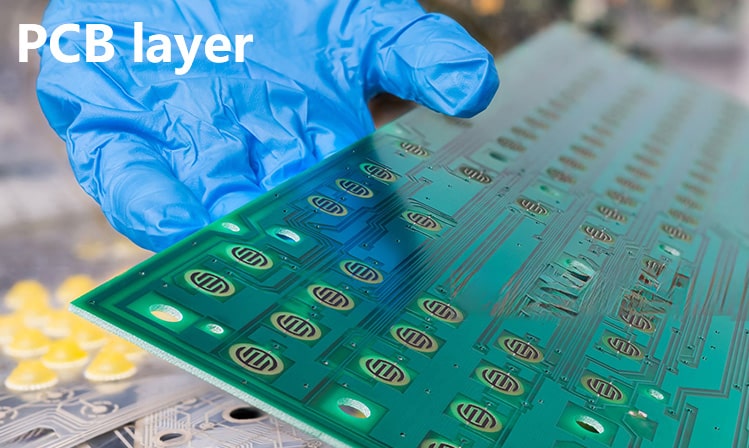
2. Check the type of vias
Through-Hole Via: A hole that runs through the entire board. The number of layers cannot be directly judged.
Blind Via: A hole that only goes from the outer layer to the inner layer (such as from the 1st layer to the 3rd layer), indicating that there is an inner layer.Conclusion: If there are blind holes or buried holes, it can be inferred that the number of layers is ≥4.
3. Board thickness estimation
Reference value:
Double-layer board: The thickness is usually 0.8-1.6mm.
4-layer board: The thickness is mostly 1.0-2.0mm.
6 layers and above: The thickness is generally ≥1.6mm.
Limitations: The thickness is affected by the substrate type (FR-4, high-frequency material) and copper thickness, and is only used as an auxiliary reference.
Light transmission inspection method
1. Strong light perspective
Method: Use a strong flashlight to illuminate the surface of the PCB to observe whether the internal traces are visible.
Result:
If the internal copper layer (such as the power layer or the ground layer) can be seen when the light is transparent, it is usually 4 layers or more.
If it is completely opaque (high-density multi-layer board), it may be 6 layers or more.
2. Limitations:
Modern high-density PCBs may use black solder mask ink or thick copper foil, which has poor light transmittance and is difficult to observe.
Professional detection method
1. Slice analysis (destructive detection)
Method: Cut the edge of the PCB, observe the cross section with a microscope, and directly count the number of layers.
Steps:Applicable scenarios: When the number of layers needs to be accurately determined and the sample can be destroyed.
2. X-ray detection
Method: Use X-ray equipment to see through the internal structure of the PCB and directly view the routing and via distribution of each layer.Disadvantages: Requires professional equipment and is costly.
Indirect inference method
1. Circuit complexity analysisMulti-layer board: High-speed digital circuits (such as CPU motherboards, communication modules) are mostly 4 layers or more, requiring independent power layers and ground layers.
2. Reference design files or silkscreen markings
Silkscreen marking: Some PCBs will mark the number of layers on the edge of the board (such as "4L" for 4 layers).If you have PCB/PCBA/OEM/ODM needs, please contact us, We will reply within 2 hours, and complete the quotation within 4 hours or less upon request.
Delivery Services

Verified by

Link Us on